

From Stiff to Comfortable
What a Senior Black Lab Taught Me About Mobility, Behavior, and Listening to the Dog in Front of You
By Chris Moran
Guest Blogger | Professional Dog Trainer & Behavior Consultant
If you have ever lived with a senior dog, you know the sound.
That slow, creaky effort it takes for them to stand up, like every joint is filing a formal complaint at once. The pause before movement. The careful steps that say, “I will get there, just not fast.”
That was my life with a fourteen-year-old black Lab whose back end had very clearly decided it was done cooperating. He was stiff, slow, and uncomfortable. On top of that, he had started growing hostile toward strangers. Not aggressive in a dangerous way, but guarded, tense, and easily irritated. The kind of dog who used to love people and now just wanted them to keep their distance.
I took over his care, determined to make his last chapter feel supported, not just managed.
When Behavior Is Really Pain Wearing a Mask
One of the hardest things for caregivers to watch is personality change in an aging dog. A dog who was once friendly becomes snappy. A dog who loved attention now avoids touch. It is easy to label it as behavior, but more often than not, it is discomfort talking.
This Lab was not becoming mean. He was becoming sore, stiff, and unsure of his body. When moving hurts, being approached feels risky. Pain shrinks a dog’s emotional tolerance just like it does ours.
Our focus was hospice-centered. Comfort over cures. Quality of life over fixing everything.
Trying the Obvious First
Like many pet caregivers, I started with what everyone talks about. CBD. Oils, tinctures, the well-meaning recommendations that come with hopeful expectations. In his case, it did nothing noticeable. He did not get worse, but he did not get better either. His movement stayed the same. His mood stayed guarded. That does not mean CBD is useless. It just means it was not the answer for him.
That is something pet caregivers rarely hear out loud. Sometimes the first thing you try does not move the needle. That does not mean you failed your dog. It means you keep paying attention.
The Least Glamorous Change That Helped the Most
Out of both curiosity and a background in nutrition conversations, I added plain gelatin to his diet. Nothing fancy. No miracle promises. Just a slow, consistent addition.
For the first couple of weeks, nothing dramatic happened. Then, quietly, the baseline shifted. He started getting up with less struggle. His back end loosened. His movement looked less rigid and more functional. He was still old. Still gray. Still careful. But he was more comfortable in his body.
About a month in, the difference was clear enough that I stopped wondering if I was imagining it.
This was not a reversal of age. It was a reduction in discomfort. And that matters more than people realize.
The Unexpected Behavior Change
As his body softened, something else happened. His attitude changed.
The dog who had been tense around strangers became more tolerant. Less reactive. More willing to exist in shared space without feeling threatened. When a dog is not constantly guarding sore joints, they have more emotional bandwidth.
Pain and behavior are deeply connected. Reducing discomfort often reveals the dog you remember underneath.
Why Movement Still Matters in Senior Dogs
One of the biggest misconceptions about senior dogs is that slowing down means stopping engagement altogether. While high-impact exercise is no longer appropriate, purposeful movement still matters.
Dogs do not lose their instincts just because they age. They lose their ability to express them the same way. When instinct goes unmet, frustration builds quietly.
With this Lab, gentle movement became part of his daily rhythm. Not long walks. Not chaotic play. Just intentional engagement that respected his limits.
Short sessions. Soft surfaces. Letting him decide when he was done. That sense of agency matters deeply for older dogs.
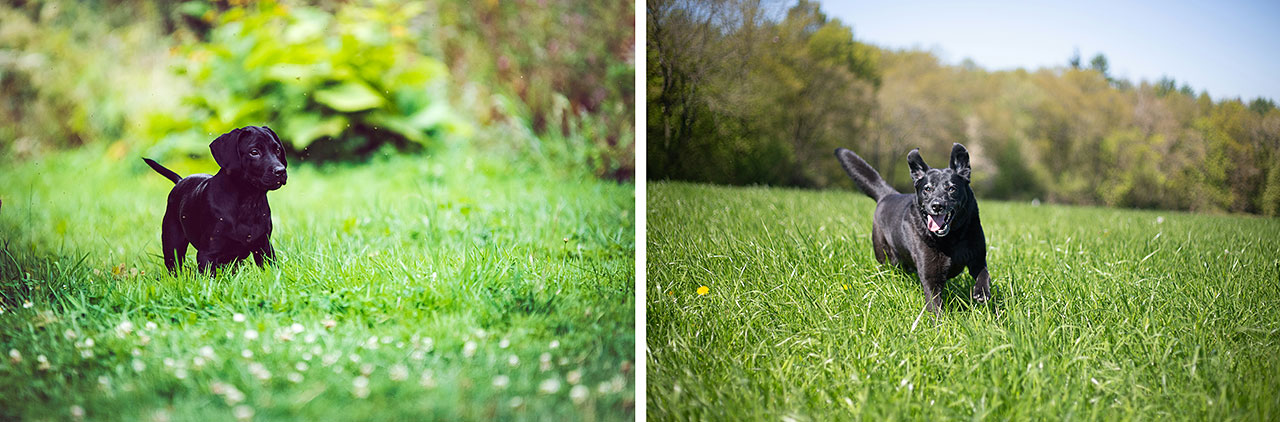
Photo caption: On the left, a black lab puppy is out in a field being active. On the right, an older black lab is sustaining mobility and running in a field.
The Bigger Lesson: Start Young if You Can
Caring for this dog also reinforced something I have seen again and again.
How a dog lives when they are young shows up loudly when they are old.
Dogs who are kept lean, appropriately active, and mentally engaged throughout life tend to age more comfortably. Not perfectly, but better. Strong muscles support aging joints.
Balanced movement protects mobility. Structured activity prevents years of wear from chaotic overuse or complete inactivity.
You cannot undo everything in the senior years, but you can absolutely influence how heavy that final chapter feels.
Senior Dog Care Is a Series of Small Experiments
There is no single answer for senior dog care. It is a process of gentle observation.
You try something safe.
You give it time.
You watch for subtle improvements.
You work alongside your veterinary team.
You adjust.
Sometimes the change is physical. Sometimes it is emotional. Sometimes it is simply making your dog more comfortable existing in their own body.
That is not nothing. That is everything.
The Quiet Win
This fourteen-year-old Lab did not become young again. He did not sprint. He did not bounce.
But he moved with less effort.
He tolerated people again.
He participated in life instead of bracing against it.
For a senior dog in hospice care, that is a meaningful win.
Our job is not to keep them forever. It is to help them feel supported, dignified, and connected for as long as they are here.
Creaks, gray hairs, and all.

Meet the guest blogger, Chris MoranChris Moran is a 5-star rated professional dog trainer and behavior consultant focused on instinct-based enrichment, impulse control, and strengthening the bond between dogs and their owners. His work at Instinctual Balance Dog Training centers on helping dogs feel balanced in both body and mind at every stage of life. He also runs Whimsy Stick LLC, a dog enrichment brand centered on safe, structured play, that leaves dogs instinctually satisfied and bonded with their owners. whimsystick.com | Whimsy Stick on Instagram @whimsysticktoy |
( Please show us all that you like this article by sharing, commenting, and/or giving this a "LIKE" on Facebook. Photo: Senior Black Lab dog facing the camera while laying down - From Stiff to Comfortable: What a Senior Black Lab Taught Me About Mobility, Behavior, and Listening to the Dog in Front of You AHG Guest Blog Post. )